English
- All
- Product Name
- Product Keyword
- Product Model
- Product Summary
- Product Description
- Multi Field Search
Views: 193 Author: Site Editor Publish Time: 2026-02-24 Origin: Site
A V-Bank Filter plays a central role in high-performance HVAC systems by capturing airborne contaminants efficiently while supporting strong airflow. Its design is engineered specifically for situations requiring high dust-loading capacity, long service life, and consistent filtration efficiency. Understanding what a V-Bank Filter does helps facility managers, HVAC professionals, and industrial operators make informed decisions about indoor air quality management and operational efficiency. This article explores the true function of a V-Bank Filter, how its structure influences overall performance, and why it stands out in commercial and industrial environments.
A V-Bank Filter is designed to clean incoming air by trapping dust, debris, allergens, and fine particulate matter as air passes through the HVAC system. Unlike flat-panel or pleated filters, it uses a multi-pocket V-shaped frame to maximize the available filtration area. Because of this geometry, a V-Bank Filter can hold more contaminants before airflow resistance increases, which helps the HVAC system operate efficiently over a longer period. In essence, it filters air while maintaining low pressure drop, enabling large commercial units to deliver stable airflow without requiring frequent replacements or excessive energy use.
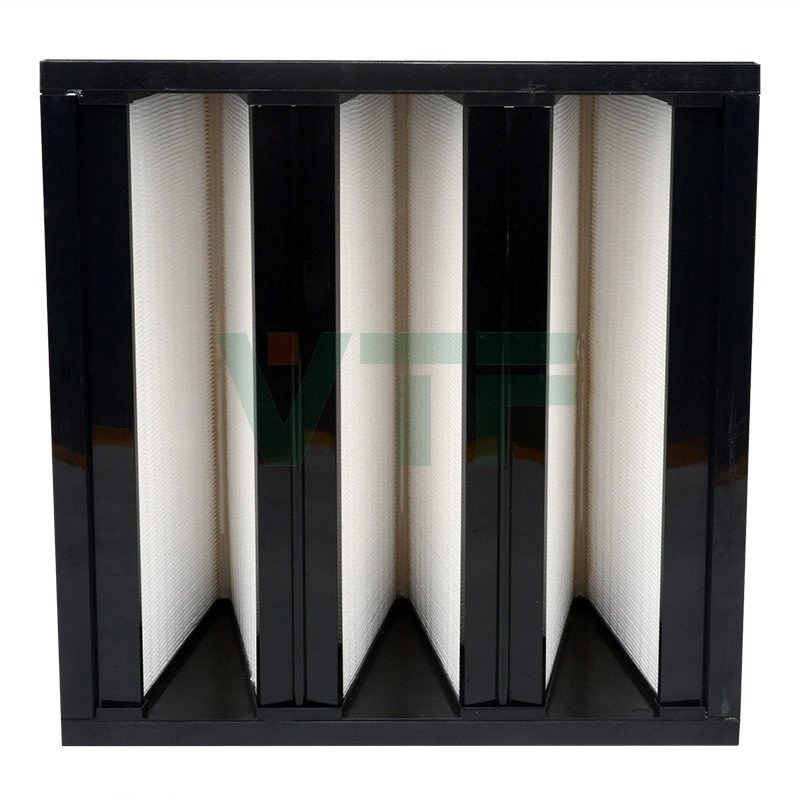
The defining feature of a V-Bank Filter is its multi-V configuration. Each “V” acts as an independent pocket, allowing additional depth and expansion of the media surface. This increases the filter’s total surface area dramatically compared with traditional filters. More surface area means greater dust-holding capacity, enhanced airflow distribution, and extended operational life.
Because airflow is distributed across multiple V-banks instead of pushing through a single plane, the filter can manage high air volumes without collapsing or clogging prematurely. This design also helps reduce pressure drop because air can pass through a larger surface with less resistance. For facilities with continuous or high-volume airflow needs—data centers, pharmaceutical plants, hospitals—the V-shape is a structural advantage that directly improves reliability, longevity, and overall filtration performance.
One of the primary functions of a V-Bank Filter is to support strong airflow while minimizing energy consumption. HVAC systems require significant power to move air through ducts and filtration media. If a filter creates too much resistance, the system must work harder, increasing operational costs and reducing mechanical lifespan. V-Bank Filters counter this problem by using a deep-pleat design that spreads resistance across multiple channels, reducing the pressure drop typically associated with high-efficiency filters.
This design supports stable airflow even as dust accumulates. Over time, this translates into measurable energy savings and fewer strain cycles on fans or blowers. Facilities with large air-handling units benefit the most, as the combination of high filtration capacity and low resistance aligns with goals of sustainability, cost control, and equipment longevity. The energy-efficient performance is a primary reason V-Bank Filters are preferred in high-demand HVAC environments.
A V-Bank Filter is capable of capturing a wide range of airborne contaminants, including fine dust, pollen, mold spores, PM2.5 particles, smoke, and industrial residues. Many V-Bank Filters meet MERV 13–16 or even HEPA-level standards depending on the media composition. This makes them suitable for environments where cleanliness and air purity are critical.
The filter’s multi-pocket structure ensures that contaminants are trapped evenly throughout the media, which avoids premature loading in any single area. This uniform distribution improves filtration consistency and helps maintain ratings throughout the filter’s lifespan. Whether used to protect sensitive electronics, support cleanroom environments, or safeguard human health in commercial spaces, a V-Bank Filter performs by offering stable, reliable, and high-efficiency contaminant removal at all stages of operation.
V-Bank Filters are especially effective in environments with high airflow requirements or long runtimes. Facilities like hospitals, laboratories, airports, food-processing plants, and manufacturing operations depend on consistent air quality to maintain safety and meet regulatory standards. In such settings, frequent filter changes are impractical and costly.
Because a V-Bank Filter provides high dust-holding capacity and strong structural integrity, it can operate for extended intervals without performance degradation. This makes them ideal for large HVAC units, high-moisture environments, or systems exposed to fluctuating temperatures. Data centers—where cooling efficiency and airflow stability directly impact electronics performance—also rely heavily on V-Bank Filters to maintain clean, temperature-controlled environments.
The most notable advantages of using a V-Bank Filter revolve around efficiency, durability, and long-term cost savings. Facilities benefit from the filter’s large surface area, which prolongs service life and reduces maintenance frequency. The reinforced housing ensures stability under high airflow velocities, making it suitable for demanding industrial applications.
Additionally, because V-Bank Filters maintain low pressure drop, they help reduce energy consumption significantly. Their compatibility with a variety of filtration media—synthetic, fiberglass, nanofiber—makes them adaptable to different indoor air quality requirements. The following table summarizes the primary benefits:
| Advantage | Description |
|---|---|
| High Dust-Holding Capacity | Captures more contaminants before needing replacement |
| Low Pressure Drop | Maintains airflow efficiency and reduces energy costs |
| Extended Lifespan | Requires fewer changes than traditional filters |
| Strong Structural Integrity | Performs well under high airflow conditions |
| Suitable for High-Performance HVAC | Ideal for hospitals, labs, data centers |
To fully understand what a V-Bank Filter does, it helps to compare it with common HVAC filter types. Flat-panel filters are inexpensive but low-performing, while pleated filters offer moderate performance but shorter lifespans. Bag filters provide good efficiency but often lack rigid structural support. V-Bank Filters combine the best qualities of these alternatives: high efficiency, low resistance, and strong durability.
Compared with bag filters, V-Bank Filters maintain shape better and handle higher air velocities. Compared with pleated filters, they offer significantly more surface area. And compared with HEPA filters, they provide strong performance without the extreme pressure drop.
Here is a concise comparison:
| Filter Type | Filtration Efficiency | Airflow Resistance | Best Use Case |
|---|---|---|---|
| Flat Panel | Low | Low | Basic residential |
| Pleated | Medium | Medium | Light commercial |
| Bag Filter | Medium–High | Medium–High | Large HVAC systems |
| V-Bank Filter | High | Low | Industrial & high-demand systems |
| HEPA | Very High | Very High | Cleanrooms, hospitals |
Selecting the right V-Bank Filter involves evaluating airflow requirements, pressure drop thresholds, MERV ratings, filter depth, and environmental conditions. Facilities with heavy particulate exposure may require synthetic or nanofiber media. Systems with strict regulatory standards may need higher MERV or HEPA-level filtration.
It is also essential to assess the HVAC system’s maximum allowable pressure drop to avoid energy spikes or mechanical strain. Some installations may require a deeper filter with more “V” pockets, while others prioritize lightweight frames for easier installation. Proper selection ensures the filter performs optimally and delivers clean air without compromising efficiency.
A V-Bank Filter improves air quality by capturing contaminants while supporting high airflow and maintaining low energy consumption. Its multi-pocket V-shaped design expands surface area, increases dust-holding capacity, and reduces the frequency of filter replacements. Because of its durability, low pressure drop, and superior efficiency, it is widely used in commercial and industrial environments with demanding air quality requirements. Understanding what a V-Bank Filter does helps organizations choose air filtration solutions that promote cleaner, healthier, and more efficient HVAC operation.
1. What is the main purpose of a V-Bank Filter?
To capture airborne contaminants while maintaining strong airflow and low pressure drop in high-performance HVAC systems.
2. Where are V-Bank Filters commonly used?
They are primarily used in hospitals, laboratories, manufacturing plants, data centers, and other environments requiring consistent air quality.
3. How long does a V-Bank Filter last?
Depending on usage and environmental conditions, many V-Bank Filters last significantly longer than pleated or bag filters due to their large surface area.
4. Are V-Bank Filters energy-efficient?
Yes. Their multi-pocket design reduces airflow resistance, lowering energy consumption across the HVAC system.
5. What contaminants can a V-Bank Filter remove?
Dust, pollen, mold spores, smoke, PM2.5 particles, and industrial byproducts depending on the filter's media and MERV rating.