English
- All
- Product Name
- Product Keyword
- Product Model
- Product Summary
- Product Description
- Multi Field Search
Views: 0 Author: Site Editor Publish Time: 2026-10-08 Origin: Site
Dealing with dust ruining a perfectly prepped clear coat is a nightmare. I have seen body shops bleed thousands of dollars annually just cleaning exhaust fans and replacing burned-out motors. Overspray management is not just about keeping the shop clean. It is about protecting your bottom line. You mask a vehicle perfectly, only to watch lingering paint mist settle back onto the hood because of compromised downdraft velocity. Upgrading your filtration setup eliminates this headache entirely.
Understanding the science behind airflow and particulate capture is the key to extending the lifespan of your booth. By comparing various materials and implementing strict maintenance protocols, facility managers can protect expensive equipment, stay compliant with environmental regulations, and consistently achieve a flawless, glass-like finish.
Essential Protection: Filtration media is a fundamental requirement for trapping wet paint particles before they can exhaust into the external environment or cause mechanical damage to turbine blades.
Material Dominance: Fiberglass remains the industry standard for high-volume automotive spray booths due to its superior depth-loading capabilities and immense paint holding capacity.
Specialized Alternatives: Synthetic felt provides excellent final-stage filtration and is highly effective for dry coatings, powder applications, or fast-flashing waterborne paints.
Airflow Optimization: Properly installing a floor filter ensures optimal laminar downdraft airflow, directly reducing external overspray and mitigating internal finish contamination.
Operational Longevity: Regular maintenance guided by manometer readings and choosing the correct arrestance rating are critical to preventing booth pressurization.
In the automotive refinishing industry, controlling airborne particulates is a strict regulatory and operational requirement. Specialized, highly porous materials are engineered to capture and retain airborne paint generated during the spraying process. Standard HVAC filters are designed for dry dust. Industrial paint filters, however, must handle heavy, wet, and sticky resins without instantly blinding over.
Environmental protection agencies mandate strict compliance regarding the emission of hazardous air pollutants and volatile organic compounds. Automotive body shops must utilize certified exhaust filtration systems to prevent these toxic particulates from entering the atmosphere. The filter pad acts as the primary mechanical barrier. It strips the solid paint resins from the exhaust airstream while allowing the clean air to vent safely outside.
To fully grasp the necessity of this filtration, one must examine the mechanics of a downdraft configuration. Clean, filtered air is introduced through the ceiling plenum and flows vertically downward over the vehicle. This unidirectional airflow pushes any atomized paint that does not adhere to the surface directly toward the floor pit.
The Spray Booth Floor Filter sits directly within the exhaust trench grates, serving as your primary line of defense. As the contaminated air is pulled downward by the exhaust turbine, it must pass through this barrier. If this filter is absent, compromised, or of low quality, wet paint will bypass the floor level. It will accumulate rapidly within the exhaust plenum, ductwork, and fan blades, inevitably leading to catastrophic equipment failure and severe fire hazards.
Filtration in an automotive spray booth relies on advanced aerodynamic principles. During a typical paint application, transfer efficiency rarely exceeds 70 percent. This means that up to 40 percent of the atomized paint becomes airborne overspray. Capturing these droplets requires specific physical mechanisms rather than just a simple sieve.
The capture of wet paint relies primarily on two physical phenomena known as inertial impaction and interception.
When the exhaust fan pulls air through the floor grates, the air stream weaves through a complex web of fibers within the pad. Heavy, wet paint droplets possess significant mass and momentum. Due to inertia, these heavier particles cannot change direction as quickly as the air stream. Instead of flowing around the fibers, they collide directly into them and stick. This mechanism is inertial impaction.
Furthermore, smaller particles that manage to follow the air stream are captured through interception. As the air stream flows closely past a fiber, the physical size of the paint droplet causes it to graze the surface, where it becomes permanently trapped. The density and arrangement of the fibers dictate the overall efficiency of the booth.
A critical distinction in industrial filtration is the difference between surface loading and depth loading. Standard pleated filters utilize surface loading, meaning particles accumulate on the outermost layer. If used for wet paint, a surface-loading filter would completely clog within minutes, restricting airflow and pressurizing the booth.
Effective exhaust media utilizes depth loading. The material is constructed with a progressive density. Fibers are loosely woven on the air-entry side and become increasingly dense toward the air-exit side. This structural design allows larger paint droplets to penetrate deep into the 2 to 3-inch pad before being trapped. Smaller particles are caught near the dense backing. Depth loading maximizes the holding capacity, allowing the pad to absorb pounds of wet paint while maintaining stable cubic feet per minute airflow rates.
Selecting the correct material is vital for optimizing booth performance. Spun glass fibers and synthetic felt are the two most prevalent materials used today. Each possesses distinct structural characteristics suited for different coating applications. Understanding these differences will save your shop from premature filter replacements and ruined paint jobs.
Fiberglass Paint Stop Media is universally recognized as the industry standard for high-volume liquid paint applications. This includes heavy clear coats, primers, and traditional solvent-based base coats.
The primary advantage of fiberglass is its exceptional continuous filament structure, which inherently supports aggressive depth loading. Premium grades, such as PA-50 or PA-100, offer incredible holding capacities ranging from 15 to 22 kilograms per square meter. This makes fiberglass highly cost-effective for busy collision centers. Its resilient structure resists collapsing under heavy liquid loads, ensuring that airflow remains stable until the matrix is fully saturated.
Paint Mist Felt is typically constructed from synthetic, non-woven polyester or a paper-polyester composite. It features a much tighter, uniform fiber matrix compared to the open weave of spun glass.
While it lacks the massive holding capacity of fiberglass for heavy wet coats, synthetic felt excels in finer particulate capture. It is highly effective for dry dust, powder coatings, or fast-drying waterborne paints that atomize into microscopic dry particles before reaching the floor. In advanced exhaust systems, this felt is utilized as a secondary stage, placed downstream from the primary fiberglass layer to catch any bypass dust.
Feature | Fiberglass Media | Synthetic Mist Felt |
|---|---|---|
Best Application | Heavy clear coats, solvent-based paints | Waterborne paints, powder coating, dry dust |
Filtration Mechanism | Progressive depth loading | Surface and tight-matrix interception |
Holding Capacity | Extremely High, up to 22 kg/m² | Moderate to Low for wet liquids |
Airflow Resistance | Low initial pressure drop | Higher initial resistance |
Investing in premium filtration yields measurable improvements in operational safety and product quality. Empirical data from the shop floor highlights several specific ways these barriers protect your business.
When paint particles bypass a cheap filter, they accumulate directly on the exhaust fan blades. Wet paint buildup causes the fan assembly to become unbalanced. This leads to severe vibration, premature bearing failure, and eventual motor burnout. High-grade media traps the solids before they reach the plenum, drastically reducing maintenance costs and unexpected downtime.
A clogged filter restricts exhaust airflow. When the exhaust turbine cannot remove air as fast as the intake fan supplies it, the booth becomes positively pressurized. This pressure imbalance creates turbulent air currents that lift settled dust from the floor and walls, depositing it directly onto the wet vehicle.
Failing to capture overspray internally means exhausting it externally. Airborne paint expelled from the exhaust stack can travel significant distances, landing on neighboring vehicles and adjacent buildings. High-efficiency barriers prevent this external contamination, mitigating the risk of costly liability claims.
Automotive coatings contain highly flammable compounds and solid resins. Accumulation of these materials in unprotected ductwork creates a severe fire hazard. By trapping combustible solids safely within a disposable pad, the risk of a catastrophic booth fire is minimized.
Recent shifts in automotive refinishing lean heavily toward waterborne basecoats and ultra-low emission high-solid clear coats. This shift is driven by stringent environmental mandates across the globe. Because waterborne paints atomize into much finer droplets and flash off rapidly in the airstream, the resulting overspray often reaches the exhaust pit as a semi-dry, microscopic dust rather than a heavy liquid droplet.
Traditional single-layer coarse filters struggle to catch this fine dust. Consequently, we are seeing a massive industry trend where facility managers upgrade to dual-stage filtration systems. They combine a heavy-duty fiberglass primary layer with a tighter synthetic secondary layer. This setup ensures compliance with evolving emission standards while keeping the exhaust turbine perfectly balanced.
When outfitting a downdraft system, selecting the appropriate material is a technical decision that impacts daily efficiency. Making a data-driven choice requires understanding critical performance metrics and matching them to your spray habits.
In industrial filtration, performance is measured through standardized testing protocols like ASHRAE. The most critical metric for automotive applications is Paint Arrestance. This refers to the percentage of total overspray weight that the pad successfully captures before the air exits the building.
For high-volume spray booths, industry standards require an arrestance rating of 98 percent or higher. A low arrestance rating allows significant particulate bypass, leading to mechanical strain. A high arrestance rating effectively traps the vast majority of solids, maintaining the integrity of the exhaust ductwork. Look for products boasting PA-50 or PA-100 specifications to guarantee this level of protection.
Procurement managers must decide between purchasing pre-cut pads or bulk continuous rolls. Pre-cut pads are ideal for standardized booths with uniform grate sizes. They reduce installation time and minimize labor costs since technicians can quickly swap individual sections. Bulk rolls are highly cost-effective for custom-sized pits or high-production facilities. Rolls allow technicians to cut exact lengths, ensuring a seamless fit across long exhaust trenches and eliminating bypass gaps.
Even the highest-rated material will fail if installed incorrectly. Implementing a strict Standard Operating Procedure for filter management is vital for extending the lifespan of mechanical components and ensuring a sterile painting environment.
Proper installation is about preventing bypass. Bypass occurs when high-velocity air finds the path of least resistance around the edges of the pad, carrying wet paint directly into the exhaust system.
Clean the Pit: Before installing new media, thoroughly scrape the exhaust pit and grate supports. Even a quarter-inch of dried clear coat on the supports will lift the new filter, creating a high-velocity bypass gap.
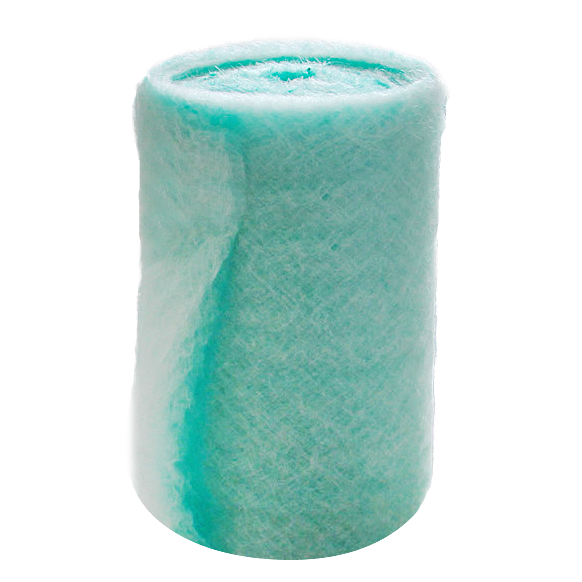
Determine Orientation: Fiberglass relies on progressive density. The loosely woven, colored side must face upwards toward the booth ceiling. The dense, white backing is the air-exit side and must face downwards into the exhaust pit.
Measure and Cut: Cut the material to extend slightly beyond the edges of the pit opening. A two-inch overlap ensures that when the heavy metal grates are placed back on top, they compress the edges, creating a tight mechanical seal.
Secure the Grates: Carefully lower the floor grates back into position. Avoid dragging the grates across the new pad, as this will tear the delicate upper fibers and destroy the depth-loading structure.
Relying solely on a calendar to determine replacement schedules is inefficient. A busy shop may blind a filter in three days, while a slower shop might get three weeks of use. Technicians should monitor empirical indicators to determine the exact end of usability.
The most accurate method is reading the manometer. This device measures the pressure differential across the filter bank. As the pad loads with paint, resistance increases. When the pressure drop reaches the manufacturer maximum limit, commonly around 0.5 to 1.0 inches of water column, the material must be replaced immediately.
Visual cues are also reliable. If wet paint begins to pool or form a solid crust on the top layer, the depth-loading capacity is exhausted. Additionally, if painters notice lingering paint fog hanging in the air after a spray cycle, the downdraft velocity has been compromised.
Operating a body shop involves managing tight margins, and it can be tempting to cut costs on consumables. However, utilizing substandard filtration ultimately increases your Total Cost of Ownership. Cheap filters lead to expensive downtime for duct cleaning, premature motor failure, and compromised paint finishes requiring costly buffing and rework.
Stop losing money on ruined paint jobs and premature fan replacements. Upgrading your facility requires reliable materials engineered for massive holding capacity and precise airflow. Whether you need bulk continuous rolls for custom trenches or pre-cut pads for standard booths, choosing premium solutions from Vitefilter guarantees optimal downdraft performance. Protect your infrastructure and consistently deliver flawless, glass-like finishes by exploring the high-performance options at Vitefilter today.
The replacement frequency depends entirely on production volume and the types of coatings being sprayed. High-production collision centers may need to replace their floor media every one to two weeks, while lower-volume custom shops might extend this to four weeks. The most objective way to determine replacement time is by monitoring the booth manometer. When the pressure drop exceeds the specified limit, airflow is restricted, and the pad must be changed to maintain a safe downdraft.
Waterborne paints atomize into finer droplets and dry much faster in the airstream than traditional solvent-based clear coats. If you use a coarse, open-weave fiberglass designed only for heavy liquids, the fine, semi-dry waterborne dust will pass directly through the fibers. This bypass will eventually coat your exhaust turbine blades, leading to severe fan imbalance and motor failure. For waterborne systems, utilizing a tighter synthetic felt or a dual-stage setup is highly recommended.
No, you cannot wash or reuse these filters. Fiberglass arrestors are designed strictly as disposable, depth-loading materials. Attempting to wash them will permanently destroy the delicate, progressive density fiber structure, rendering them useless. Furthermore, washing these materials releases chemically catalyzed paint solids and toxic solvents directly into the local water supply, which is a severe violation of wastewater regulations.
Pressure drop is measured using a manometer or a Magnehelic gauge installed on the outside of the spray booth. One pressure port is located inside the booth cabin, and the other is located in the exhaust duct directly behind the filter bank. The gauge measures the difference in air pressure between these two points. As the media fills with paint, it becomes harder for air to pass through, causing the pressure differential to rise. Always replace the media when the gauge reaches the red zone indicated by your booth manufacturer.
They serve two entirely different functions within the airflow system. Ceiling filters are located in the intake plenum. Their job is to purify the outside air coming into the booth, removing microscopic dust before it can land on the wet vehicle. Conversely, floor filters are located in the exhaust trench. Their sole purpose is to capture the wet, sticky overspray generated during the painting process before that contaminated air is exhausted out of the building.
Proper orientation is critical for depth loading. The loosely woven, colored side, which is usually green, yellow, or blue depending on the manufacturer, must face upwards toward the incoming airflow. This open structure is designed to catch larger, heavier paint particles. The dense, white backing must face downwards toward the exhaust pit. This tightly woven side serves as the final filtration stage to catch smaller particulates.
No, standard fiberglass and synthetic floor filters are exclusively designed to capture solid particulates and liquid droplets like aerosols. They do not have the chemical properties required to absorb or neutralize gases. Volatile Organic Compounds and solvent fumes will pass directly through these mechanical barriers. To capture gaseous emissions and odors, the exhaust system must be equipped with specialized active carbon filters or a thermal oxidizer system downstream from the primary particulate pads.