English
- All
- Product Name
- Product Keyword
- Product Model
- Product Summary
- Product Description
- Multi Field Search
Views: 0 Author: Site Editor Publish Time: 2026-10-30 Origin: Site
In the high-stakes realm of pharmaceutical manufacturing, environmental control leaves zero room for error. A single airborne contaminant bypassing the HVAC system triggers a cascade of catastrophic events. Batch rejections occur. Widespread product recalls follow. Inevitably, facilities face failed inspections from regulatory authorities like the FDA or EMA. To mitigate these severe operational risks, facility managers must strictly adhere to Good Manufacturing Practice guidelines. The updated EU GMP Annex 1 regulations governing air quality and sterile environments are particularly unforgiving.
At the core of this contamination control strategy lies the terminal filtration system. Serving as the ultimate line of defense, this component dictates the integrity of the entire manufacturing space. This guide explores the mechanics of high-efficiency filtration and the critical distinctions between various grades. We will also examine the rigorous validation processes mandated for continuous compliance and the essential engineering factors needed for infrastructure upgrades to ensure continuous audit readiness.
GMP Compliance: High-efficiency filtration is absolutely mandatory for achieving ISO Class 5 to 8 environments and Grade A through D cleanrooms under GMP Annex 1.
Grade Distinctions: H13 models capture 99.95 percent of the most penetrating particles, whereas H14 captures 99.995 percent. This logarithmic difference makes H14 essential for critical sterile zones.
Advanced Technology: Upgrading to a mini-pleat design offers significantly lower pressure drops and extended lifespans, drastically optimizing cleanroom energy consumption.
Validation is Key: Routine PAO leak testing and continuous pressure drop monitoring are non-negotiable practices for maintaining continuous regulatory compliance.
Smart Sourcing: Purchasing certified units from reputable manufacturers complete with full EN 1822 documentation prevents catastrophic audit failures.
Looking at the broader pharmaceutical landscape, facility design is undergoing a massive shift. The recent revisions to EU GMP Annex 1 have forced engineers to rethink their approach to contamination control strategies. Regulatory bodies now demand proactive, continuous monitoring rather than reactive periodic checks.
Simultaneously, corporate boards are heavily prioritizing energy optimization. Cleanroom HVAC systems traditionally consume up to 70 percent of a facility's total energy. Consequently, the industry is rapidly moving away from legacy deep-pleat filters. Modern facilities are transitioning toward advanced aerodynamic designs that slash initial pressure drops. This dual demand for stricter sterility and lower carbon footprints is entirely reshaping how engineers specify terminal filtration units.
A high-efficiency filter is far more than a simple sieve. It operates as a highly advanced mechanical device engineered to trap sub-micron particles through complex physical dynamics. When blowers force air through the dense micro-glass media, contaminants do not merely get stuck because they are too large. Instead, the media captures particles via three primary mechanisms. Interception occurs when particles graze a fiber and adhere. Impaction happens when heavier particles crash directly into the fibers due to inertia. Finally, diffusion traps ultrafine particles moving erratically in Brownian motion until they collide with a structural fiber.
Regulatory frameworks mandate unyielding control over both microbial and particulate airborne threats. A single viable microorganism entering an aseptic compounding area compromises an entire batch of life-saving therapeutics. To prevent this disaster, the filter acts as the final barrier. Installed directly at the air entry point of the ceiling grid, it ensures any particulate matter generated upstream within the ductwork is captured. This terminal placement delivers a continuous, unidirectional flow of ultra-clean air, physically sweeping potential contaminants away from exposed products and personnel.
To evaluate cleanroom efficiency objectively, engineers must first understand the Most Penetrating Particle Size, commonly known as MPPS. While legacy texts often assume 0.3 microns is the standard benchmark, empirical data reveals a different reality. The most difficult particles to capture typically fall between 0.12 and 0.25 microns, heavily depending on media velocity. Filtration efficiency is rigorously graded based on the ability to capture this specific, elusive particle size.
Integrating the correct H13 H14 HEPA Filter classifications is a fundamental requirement for modern pharmaceutical applications. Utilizing an inadequate grade for a highly classified space immediately results in audit failure.
Filter Grade | Efficiency at MPPS | Typical Cleanroom Application | GMP Annex 1 Zone |
|---|---|---|---|
H13 | ≥ 99.95% | Terminally sterilized manufacturing, background zones | Grade C & D |
H14 | ≥ 99.995% | Aseptic processing, filling lines, laminar flow hoods | Grade A & B |
Specifically, H13 models guarantee an overall efficiency of 99.95 percent at MPPS. These units are highly effective for background cleanrooms where product exposure remains minimal. In contrast, H14 units boast a stringent efficiency of 99.995 percent. For Grade A zones where sterile products are directly exposed to the environment, H14 is legally mandated. This logarithmic difference means an H14 unit allows ten times fewer particles to pass through compared to its H13 counterpart, providing the critical safety margin required for aseptic operations.
Historically, standard high-efficiency filters utilized corrugated aluminum separators to maintain spacing between the micro-glass media folds. While functionally adequate for decades, these bulky separators increase the risk of media puncture. They also create significant airflow turbulence and limit the total volume of media packed into a standard frame.
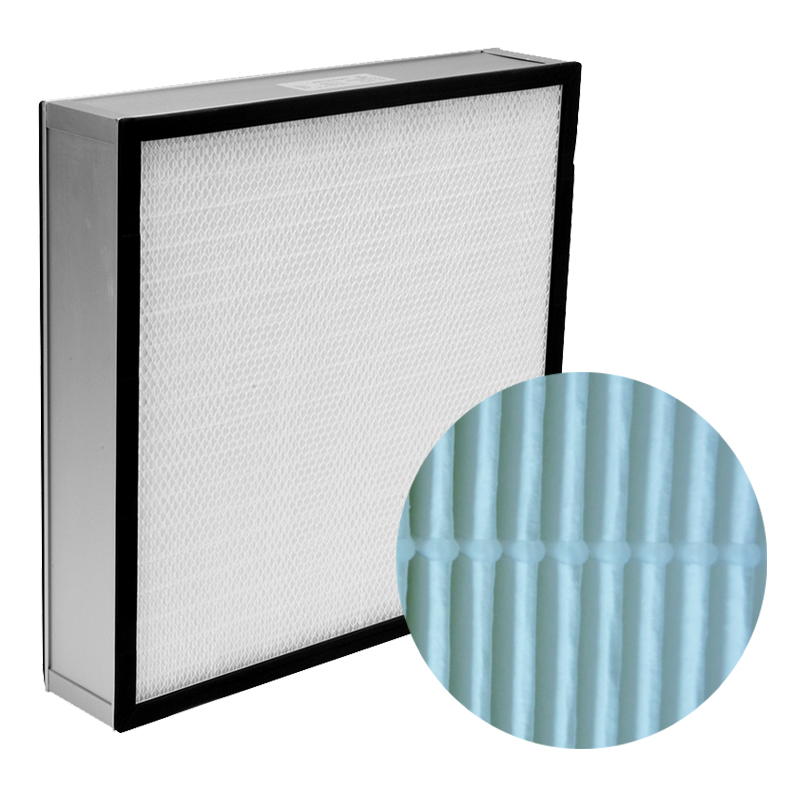
To combat these inefficiencies, the industry is rapidly transitioning to the Mini Pleat HEPA Filter. This engineered design completely eliminates bulky aluminum in favor of ultra-thin hot-melt adhesive ribbons. This structural refinement allows for a significantly higher density of filter media within a much shallower frame depth, often as slim as 50mm or 69mm.
The increased surface area translates directly into a dramatically lower initial pressure drop. For instance, high-quality mini-pleat units can achieve initial resistance levels as low as 110Pa to 160Pa. Because the HVAC blower motors do not have to work nearly as hard to overcome air resistance, continuous pharmaceutical facilities realize massive reductions in electrical energy consumption. Furthermore, the uniform spacing provided by hot-melt separators ensures a highly consistent laminar airflow. Uniform air velocity is an absolute necessity for Grade A aseptic zones to prevent unexpected turbulence from drawing contaminants into the sterile field.
Delivering sterile air into a controlled environment requires a highly engineered delivery system. A terminal HEPA Module is a comprehensive assembly installed seamlessly into the cleanroom ceiling grid. It comprises a robust housing typically constructed of anodized extruded aluminum or stainless steel, the filter media pack itself, an air distribution diffuser face, and integrated upstream test ports for validation aerosols.
One of the most critical engineering decisions involves the sealing mechanism between the filter and the housing. Commercial HVAC systems often rely on dry neoprene gaskets. However, pharmaceutical cleanrooms overwhelmingly favor fluid gel seal configurations. In this setup, the filter frame features a continuous channel filled with a non-curing polyurethane or silicone gel. The housing features a sharp knife-edge flange that bites deeply into this gel. This physical interaction creates an absolute, airtight fluid barrier.
This fluid design easily accommodates minor structural shifts, ceiling grid vibrations, and thermal expansion. It completely eliminates the risk of bypass leakage, which is a notorious culprit behind leak test failures. When flush-mounted into heavy-duty T-bar systems, these modules allow for rigorous washdown and Vaporized Hydrogen Peroxide decontamination cycles without degrading the seal.
Procuring a premium unit is only the initial step. Continuous, documented validation remains the true cornerstone of GMP compliance. This validation lifecycle divides into rigorous factory testing by the manufacturer and routine in-situ testing by the facility validation team.
Under EN 1822 protocols, every individual unit intended for a pharmaceutical environment must undergo automated scan testing before leaving the manufacturing floor. Robotic probes scan the entire downstream face to ensure zero pinhole leaks and verify overall efficiency. A unique Certificate of Conformance tied to the unit serial number must accompany the shipment.
Once installed, technicians must test the filters in place to verify no micro-fractures occurred during transit. Technicians introduce a Polyalphaolefin aerosol challenge upstream. Using a calibrated photometer, they meticulously sweep the probe across the downstream face and the perimeter seal at a controlled speed of roughly 5 centimeters per second. GMP guidelines strictly dictate that any localized leak exceeding 0.01 percent of the upstream concentration constitutes a critical failure.
Additionally, airflow velocity testing verifies that the air speed consistently meets the regulatory requirement of 0.45 meters per second for Grade A zones. Maintaining meticulous historical logs of these tests is vital, as regulatory inspectors will scrutinize these records to verify continuous environmental control.
A pervasive myth in facility management is that terminal filters possess a strict chronological expiration date. In reality, GMP regulations do not specify a mandatory replacement schedule based solely on time. When protected by well-maintained pre-filters including G4 and F8 grades in the primary air handling unit, terminal filters can reliably operate for three to five years. Replacement is dictated entirely by empirical performance metrics.
Standard Operating Procedures should trigger a mandatory change-out under specific conditions. First, engineers must monitor excessive pressure drop. When the unit accumulates enough particulate to reach its maximum allowable resistance, it must be replaced to prevent severe motor strain and degraded air change rates. Second, a failed integrity test demands immediate action. If a unit fails a routine leak test and the damage exceeds allowable patching limits, it must be discarded. Finally, any visible physical damage to the media or exposure to excessive moisture immediately compromises structural integrity.
For facilities handling highly potent active pharmaceutical ingredients, maintenance protocols must incorporate Bag-In and Bag-Out procedures. These systems allow technicians to extract and replace contaminated units entirely within a sealed heavy-duty bag, safely isolating hazardous particulate matter from personnel and the surrounding facility.
The commercial market is heavily saturated with consumer-grade products marketed under ambiguous terms like HEPA-Type or 99% HEPA. In the heavily regulated pharmaceutical sector, installing anything other than a fully documented, individually tested unit is a severe compliance violation that will result in immediate audit failure.
Material traceability is a paramount purchasing factor. The frame must be constructed from robust materials capable of withstanding aggressive cleanroom sanitization chemicals. Furthermore, the media, hot-melt separators, and potting sealants must be explicitly certified as non-shedding and off-gas free. This prevents the unit itself from becoming a source of chemical contamination within the sterile zone.
Selecting the right manufacturing partner is critical. Pharmaceutical facilities must source from suppliers that demonstrate transparent quality assurance processes and provide comprehensive factory test reports for every single unit. Look for manufacturers offering customized sizing, low initial pressure drops, and reliable polyurethane gel seals to ensure long-term operational stability.
High-efficiency filtration systems act as the absolute heartbeat of pharmaceutical cleanrooms. They bridge the critical gap between raw HVAC air and stringent GMP Annex 1 compliance. Understanding the nuanced differences between H13 and H14 classifications ensures your facility deploys the appropriate level of protection for varying operational risk zones.
Investing in advanced mini-pleat technologies and robust terminal modules with reliable gel seals stabilizes cleanroom aerodynamics. This upgrade lowers operational energy costs and provides an impenetrable barrier against contamination. Ultimately, prioritizing rigorous in-situ validation protects product efficacy, preserves brand reputation, and safeguards patient safety.
To ensure your facility remains perpetually audit-ready with verifiable material traceability, explore the engineered solutions available on the market. From custom dimensions to low-resistance mini-pleat designs, you can find the exact certified products required for your critical environments by visiting Vitefilter today.
The primary distinction lies in their verified filtration efficiency at the Most Penetrating Particle Size. H13 filters capture at least 99.95 percent of these challenging particles, making them perfectly suitable for background cleanrooms and terminally sterilized manufacturing. H14 filters capture 99.995 percent of particles. This higher efficiency is legally mandated for critical sterile environments, aseptic processing, and laminar flow hoods.
Yes, they do so highly effectively. While individual virions are typically smaller than 0.3 microns, they are highly susceptible to the diffusion mechanism of micro-glass media. Their erratic Brownian motion causes them to collide with fibers. Additionally, viruses and bacteria rarely float independently in a cleanroom. They usually attach to larger carrier particles like skin flakes or microscopic water droplets, which are easily trapped by interception and impaction mechanisms.
According to standard interpretations of GMP Annex 1 and FDA guidelines, filters located in highly critical Grade A and B aseptic processing areas must undergo PAO leak testing at least every six months. Filters situated in less critical Grade C and D background areas generally require integrity testing at least every twelve months to maintain regulatory compliance.
Mini-pleat designs replace bulky corrugated aluminum separators with ultra-thin hot-melt adhesive ribbons. This structural innovation allows for a significantly larger media surface area to be packed within a compact frame. The result is a much lower pressure drop, drastically reduced HVAC energy consumption, a longer operational service life, and a more consistent laminar airflow.
If a filter fails a routine PAO leak test, immediate corrective action is required before manufacturing can resume. If the detected leak is minor and compliant with local standard operating procedures, a validation technician may patch it using approved silicone sealants. If the damage exceeds allowable limits, the filter must be entirely replaced, and the new unit must be successfully re-tested in-situ.
Excessive humidity can severely degrade traditional micro-glass filter media. High moisture levels increase the risk of media swelling, which elevates the pressure drop and forces the HVAC system to work harder. Furthermore, prolonged exposure to condensation can compromise the structural integrity of the fibers, leading to micro-tears and subsequent leak test failures. Cleanrooms must maintain strict relative humidity controls to protect the filtration infrastructure.
For critical Grade A aseptic processing zones, regulatory bodies like the FDA and EMA generally recommend a continuous, uniform face velocity of 0.45 meters per second, with an allowable variance of plus or minus 20 percent. This specific velocity ensures a unidirectional sweep of air that effectively pushes potential contaminants away from exposed sterile products without creating disruptive turbulence.