
- All
- Product Name
- Product Keyword
- Product Model
- Product Summary
- Product Description
- Multi Field Search
 English
 Views: 0 Author: Site Editor Publish Time: 2026-06-30 Origin: Site


In strictly regulated dust-free rooms across the semiconductor, pharmaceutical, and biotechnology sectors, micro-contamination directly impacts product yield and regulatory compliance. Even a minor particle excursion can compromise entire production batches. It leads to significant revenue loss and quality control failures. Traditional centralized HVAC systems often struggle to maintain the continuous, unidirectional airflow required for these sensitive environments. They frequently leave dead zones where airborne particulates accumulate, failing to consistently meet stringent ISO classification standards.
To solve this ongoing challenge, modern facilities rely on specialized solutions to deliver precise environmental control at the ceiling level. You will learn how integrating high-performance Air Cleaning Equipment sustains flawless laminar airflow. We will explore how these decentralized units mitigate point-of-failure risks and optimize cleanroom performance. Properly specified systems provide the required velocity uniformity to sweep contaminants away effectively. This guide unpacks the essential engineering dimensions and implementation realities you must evaluate before finalizing your next facility upgrade.
Performance Baseline: FFU systems achieve laminar airflow by maintaining uniform velocity (typically 0.45 m/s ± 20%) to prevent particle turbulence.
Scalability & Control: Decentralized FFU networks offer modular scalability and isolated point-of-failure mitigation compared to centralized air handling units.
Evaluation Criteria: Effective procurement requires assessing motor efficiency (ECM vs. AC), filter grade (HEPA vs. ULPA), and housing materials against specific facility compliance requirements.
Implementation Reality: Ceiling grid compatibility, static pressure capabilities, and lifecycle maintenance downtime are the primary operational bottlenecks to evaluate before shortlisting vendors.
Standard air distribution methods create internal vortexes and turbulent eddies. These vortexes trap particulates in the ambient air. They prevent contaminants from exiting the critical zone efficiently. Laminar flow takes a completely different mechanical approach. It utilizes continuous, parallel airstreams to gently sweep airborne contaminants downward. The clean air pushes particles toward low-level return grilles. This unidirectional method prevents cross-contamination between workstations. It guarantees immediate removal of particles generated by operators or machinery.
Pressurized plenums and micro-glass fiber media work together mechanically. They distribute incoming air evenly across the entire filter face. The primary FFU mechanism relies on an internal blower to draw air from the ceiling plenum. It forces this air through a highly dense filter matrix. Internal baffling plates guide the airflow perfectly. They prevent the air from channeling directly below the motor hub. This design ensures every square inch of the filter media receives equal air volume.
Velocity uniformity acts as the absolute engineering baseline for success. Industry standards dictate a consistent air velocity of 0.45 meters per second. Variability across the filter face inevitably leads to cleanroom dead zones. If one section drops below the target velocity, negative pressure pockets form. These pockets pull unfiltered surrounding air into the clean zone. You must specify units capable of delivering an unbroken column of air. Uniform velocity prevents localized turbulence and protects critical process yields.
Choosing the correct filtration grade determines your compliance baseline. Facilities must differentiate carefully between HEPA and ULPA technologies based on ISO 14644 class requirements. HEPA filters trap 99.99% of particles at the 0.3-micron threshold. They serve ISO Class 5 to ISO Class 8 environments effectively. ULPA filters capture 99.9995% of particles down to 0.12 microns. You need ULPA technology for extreme sub-micron control in ISO Class 3 and Class 4 environments.
Evaluating media seal integrity prevents bypass leaks in high-stakes environments. A compromised seal negates the best filter media. Gasket seals use neoprene or silicone foam compressed against the ceiling grid. They work well but can degrade over extended periods. Gel seals offer a vastly superior alternative for critical applications. They utilize a non-Newtonian fluid channel that the filter knife-edge penetrates. This creates a flawless, airtight barrier. It remains intact even during minor structural shifts.
Filtration Metric | HEPA Media | ULPA Media |
|---|---|---|
Efficiency Rating | 99.99% | 99.9995% |
Target Particle Size | 0.3 μm | 0.12 μm |
ISO Class Application | ISO Class 5 - 8 | ISO Class 1 - 4 |
Pressure Drop (Initial) | Moderate (~100-120 Pa) | High (~140-160 Pa) |
Conducting a rigorous analysis of AC motors versus Electronically Commutated Motors (ECM) is mandatory. AC motors provide a lower initial component expense. However, they operate at fixed speeds and consume significant electricity. ECMs utilize a built-in microprocessor to adjust speed dynamically. They represent a monumental leap in operational efficiency. While they demand a higher initial layout, the long-term energy profile looks completely different.
Addressing the operational expenditure impact helps justify the technology choice. ECMs typically reduce direct energy consumption by up to 50 percent. This reduction drops utility bills drastically over a ten-year lifespan. Furthermore, ECMs generate far less sensible heat during continuous operation. AC motors radiate excess heat directly into the cleanroom envelope. By adopting ECM technology, you simultaneously reduce the secondary cooling loads placed on the primary HVAC chillers.
Assessing noise criteria (NC) levels protects operator health and safety. High-density arrays often create significant occupational noise. A ceiling filled with hundreds of running blowers generates a compounding acoustic effect. You must rigorously evaluate internal baffling claims and sound-damping insulation quality. Top-tier manufacturers integrate specialized acoustic foam inside the housing. This dampens the specific frequency bands generated by the blower wheel. Aim for individual unit ratings below 50 dBA at standard operational speeds.
Vibration isolation demands close attention in highly sensitive facilities. Facilities utilizing sensitive metrology tools or lithography equipment cannot tolerate micro-vibrations. Unbalanced impellers transmit kinetic energy directly through the ceiling grid. This energy travels down walls and disrupts nanometer-scale manufacturing processes. Specify dynamic balancing for all rotating components. Require vibration isolation pads between the motor mount and the exterior casing. This physical separation breaks the vibration transmission path effectively.
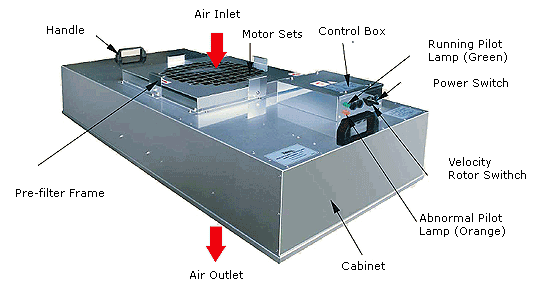
Assessing housing dimensions against your cleanroom ceiling grid is a critical early step. You must match the hardware to existing or planned structural profiles. Standard 2x4 configurations dominate general cleanroom layouts. However, advanced pharmaceutical suites often utilize custom teardrop profiles. These custom profiles minimize airflow disruption along the ceiling joints. Ensure the chosen unit drops perfectly into the T-grid without forcing. Improper fits cause microscopic gaps that destroy room pressurization.
Analyzing how the system handles increased static pressure ensures longevity. Filters physically load with captured particulates over time. As the media clogs, the internal airflow resistance rises sharply. The blower must increase its output to maintain the required 0.45 m/s velocity. If the equipment lacks adequate static pressure capabilities, velocity will drop unexpectedly. This compromises the entire laminar flow paradigm. You should map out the following filter loading stages:
Initial Clean State: Low pressure drop; blower runs at minimal RPM.
Mid-Life Loading: Particulates accumulate; ECM automatically ramps up RPM to compensate for resistance.
Terminal Resistance: Filter reaches maximum safe pressure limit; monitoring systems trigger replacement alarms.
Integrating pre-filters extends the terminal HEPA or ULPA lifecycle significantly. Coarse particles should never reach the primary micro-glass media. Pre-filters capture larger dust particles before they enter the main blower chamber. This simple addition reduces long-term replacement frequency. Swapping a top-mounted pre-filter takes minutes and causes zero cleanroom downtime. It is an operational necessity for maintaining consistent performance.
Evaluating group control capabilities ensures scalable facility management. Modern dust-free rooms rely on sophisticated networked control systems. Look for seamless BMS integration and Modbus or BACnet compatibility. Hardwired or wireless networks allow operators to manage hundreds of units simultaneously. Real-time monitoring tracks exact RPMs and pressure drops across different zones. You can apply targeted zoning strategies. This lets you adjust airflow dynamically in specific areas without altering the entire room.
Moving beyond basic unit cost separates amateur procurement from professional facility management. Upfront capital expenditure represents only a fraction of the overall equation. You must carefully factor in long-term energy consumption rates. Consider the precise frequency of filter replacements required by your ambient environment. Labor costs for maintenance also add up quickly. Swapping heavy terminal filters requires specialized personnel and intense recertification procedures. Selecting equipment designed for fast, tool-less filter changes minimizes this burden.
Balancing compliance and durability guides housing material selection. Standard powder-coated cold-rolled steel works for general manufacturing spaces. However, it lacks robust chemical resistance. Galvalume offers better moisture protection but may not meet aggressive sterilization standards. Stainless steel (SUS 304 or 316) remains the gold standard for pharmaceutical use. It withstands harsh vaporized hydrogen peroxide (VHP) washdowns perfectly. You must evaluate these materials through the strict lens of chemical resistance and outgassing restrictions.
Housing Material Evaluation Chart | |||
Material Type | Chemical Resistance | Outgassing Risk | Best Application Scenario |
|---|---|---|---|
Powder-Coated Steel | Low | Moderate | Standard electronics assembly |
Galvalume | Moderate | Low | General ISO 7/8 environments |
Stainless Steel (SUS 304) | High | Zero | Pharmaceutical / Biologics |
Vetting manufacturer data demands strict skepticism and independent verification. Do not accept internal marketing brochures as scientific fact. You must demand independent testing certificates for filter efficiency. Request documented evidence of motor lifespan expectations. Review the documented Mean Time Between Failures (MTBF) for the entire Air Cleaning Equipment assembly. Legitimate vendors gladly provide third-party validation reports from recognized acoustic and aerodynamic testing laboratories.
Treat your specialized air delivery procurement as a facility-critical investment rather than a generic commodity purchase. Substandard systems compromise product yield and risk compliance failures.
Prioritize ECM technology and gel-sealed media to ensure long-term stability. The energy savings and leak-proof performance justify the initial selection effort.
Mandate rigorous structural and acoustic compatibility checks before finalizing any vendor contract. Noise and vibration issues are nearly impossible to fix post-installation.
Recommend a localized pilot installation or a detailed facility computational fluid dynamics (CFD) model. This serves as the most logical actionable step before committing to a full-scale ceiling grid rollout.
A: Typically 3 to 5 years, heavily dependent on ambient air quality, pre-filtration strategy, and continuous operating hours. Monitor pressure drop rather than relying strictly on calendar timelines.
A: Yes, but it requires verifying the structural load capacity of the existing ceiling grid and ensuring the primary air handling unit can supply adequate makeup air to the FFU plenum.
A: ECMs provide precise variable speed control, allowing facilities to dial back RPMs during non-operational hours (setback mode) while maintaining baseline pressure cascades, drastically cutting energy use.